
From 88% Traffic Loss to 514% Growth: Honest SEO Case Studies

Bottom Line Up Front: SEO guarantees don't exist. Not every sector can hit top 10 without massive investments. But with the right strategy, patience, and honesty? Results like 6% to 36% visibility in 30 days are absolutely achievable. We'll show you with real numbers, screenshots, and a painful story about what goes wrong without proper migration.
The truth other agencies won't tell you
You've just invested €15,000 in a stunning new website. The design is sharp, the content is solid, and you're ready to dominate online.
Two weeks later? Your traffic has plummeted by 88%.
Your rankings? Gone.
Featured snippets that took months to earn? Vanished.
This isn't a hypothetical scenario. This happened to a business we'd successfully built to 32% visibility, but who then chose another agency. Within 14 days, everything collapsed. Today, months later, their visibility sits at just 5%.
Here's the thing: this disaster was 100% preventable. And it perfectly illustrates why SEO is more than pretty promises.
In this blog, no polished success stories. Instead: hard numbers, honest insights, and the difference between amateurs and strategic SEO work.
Why not every niche is equally achievable
The harsh reality: competition determines your ceiling
Let's be honest. If you start a webshop selling general women's clothing, you'll never beat Zara, H&M, or Zalando. Their SEO budgets? Higher than your entire annual revenue.
Does this mean SEO is pointless? Absolutely not. It means you need to be smarter: go nicher, target more specific audiences, and focus on long-tail keywords where volume is lower but conversion is much higher.
The fashion giants dominate "women's clothing" and "summer dresses". But "fair trade linen dresses plus size" or "vintage-inspired cocktail dresses Belgium"? That's where opportunities lie for the smart player.
The keyword dilemma: volume versus relevance
One of the biggest challenges in specific niches? Finding keyword volumes worth pursuing.
Take shoes, for example.
"shoes" - Volume? Yes. Achievable? No. Too competitive and far too broad.
"women's shoes" - Still enormously competitive. Thousands of webshops compete for this position.
"handmade leather hiking boots for women" - More specific, but often barely any search volume.
Here's the smart strategy: by optimizing for that long-tail (handmade leather hiking boots for women), you automatically target the broader terms too. You optimize for the specific keyword, but "hiking boots", "women's shoes" and even "shoes" are implicitly included.
Will you immediately hit top 10 for those broad terms? Probably not. But you're in the game. And with strategy, patience, and the right content? You never know.
The reality: it's a balancing act. That's why we always determine in consultation with the client which keywords are most relevant for their business goals. Because what's the point of position 1 on a keyword nobody searches for, or that generates zero conversions?

Our approach: no magic, just data and strategy
At Fennec Group, we don't work on gut feeling or wild promises. We work with data, analysis, and transparency. Our strategy is built on SERP analysis of the top 3 competitors in Google. We dissect what works, what doesn't, and where the opportunities lie.
How we do it
1. Competitor analysis: dissecting the top 3
We scrape and analyze the complete content of the top 3 competitors in search results. But because manually copying content is time-consuming, error-prone, and inefficient, we developed a custom Python scraper/parser tool.
This tool retrieves all relevant SEO data: headers (H1, H2, H3), paragraph content, image alt tags, meta titles, meta descriptions, structured data, and more. It accelerates our work and dramatically improves the accuracy of our analyses.
Why this matters: we know exactly what Google values in your niche. We see which content ranks, which structure works, and which keywords actually generate conversions.
2. Keyword research: finding volumes in difficult niches
We search for keywords with both volume and relevance. In some niches, this takes weeks. Why? Because there's simply little to no search volume on relevant terms.
Example: a highly specific B2B service in the industrial sector. Search volumes? Nil. But in B2B, it's about quality, not quantity. One prospect with high purchase intent is worth more than a thousand tire-kickers.
This is custom work. Not a standard list from an SEO tool, but strategic research into what your target audience actually searches for.
3. Content optimization: starting from your story
We always start from our client's existing content—their story, their expertise, their unique selling points. Based on our competitor analysis, we identify what works and what doesn't in the top 3.
Then we rewrite, polish, and expand the client's own content. No copy-paste from competitors. No stolen text. Instead: original content that's better than what's already there, optimized with insights from our analysis.
4. Technical SEO: maximizing every platform
We work with various platforms like Shopify, Wix Studio, WordPress, and others. Each platform has its own capabilities and limitations. As Shopify Partners and Certified Wix Studio Designers, we know exactly what is and isn't possible within each platform.
And that's precisely where our strength lies: we extract the maximum from every system.
What's always possible:
Adding structured data (rich snippets, FAQs, product schema)
Optimizing images and videos for load time without quality loss
Improving internal link structure for better crawlability
Optimizing robots.txt for efficient Google crawling
Some platforms give you complete control over code and hosting, others don't. We know how to achieve the best SEO results within any environment.
5. On-page and off-page optimization
We ensure a holistic approach: on-page content, technical SEO, and where possible off-page strategies like link building and brand mentions. Everything is aimed at sustainable, measurable growth.
The golden rule: 1 to 2 keywords per page
Many businesses make a crucial mistake: they try to optimize one page for 10 different keywords simultaneously. That doesn't work.
Our rule is crystal clear: 1 to a maximum of 2 relevant keywords per page. Focus delivers results. Fragmentation leads to mediocre rankings across the board.
One page, one clear message, one to two keywords. Simple. Effective.
Case Study 1: When a website migration becomes a disaster
Metrics | Situation BEFORE | Situation AFTER (new Agency) |
Visibility | 32% | 5% (-84%) |
Keywords position 1 | 19 | 2 (-89%) |
Keywords top 10 | 81 | 8 (-90%) |
Featured snippets | 5 | ~0 |
Thumbnails | 39 | ~0 |
Timeline | After 4-5 months of SEO ranking growth. | Within 2 weeks after the new site goes live |
The context: how it started
A business came to us after a failed partnership with another agency. They wanted a professional website that was actually findable. We built a completely new website with a fresh domain and started with SEO.
After 4-5 months, we had built solid results:
32% visibility across 250 tracked keywords
19 keywords at position 1 in Google
81 keywords in top 10
5 featured snippets (the highlighted answer boxes at the top of Google—extra visible and authoritative)
39 thumbnails (images appearing in Google search results—attract more attention and clicks)
For a new website with a new domain? Those are strong numbers. Organic traffic grew steadily, leads came in, and everything pointed to continued growth.
What happened next: impatience and false promises
SEO requires patience. Conversions don't come in weeks, but in months. Rankings need to stabilize. Authority needs to grow. That's reality.
The business became impatient. A competitor approached them with promises that "everything could be better". Without warning, the business decided to switch.
This new agency got to work and decided on:
A completely new platform (WordPress instead of the well-functioning existing platform)
A complete redesign, despite design not being the problem
Replacing all SEO-optimized content with new text written without SEO knowledge
No proper 301 redirects during migration
Those last two—no content preserved and no 301 redirects—are a deadly combination. All built-up SEO value? Gone like snow in the sun.
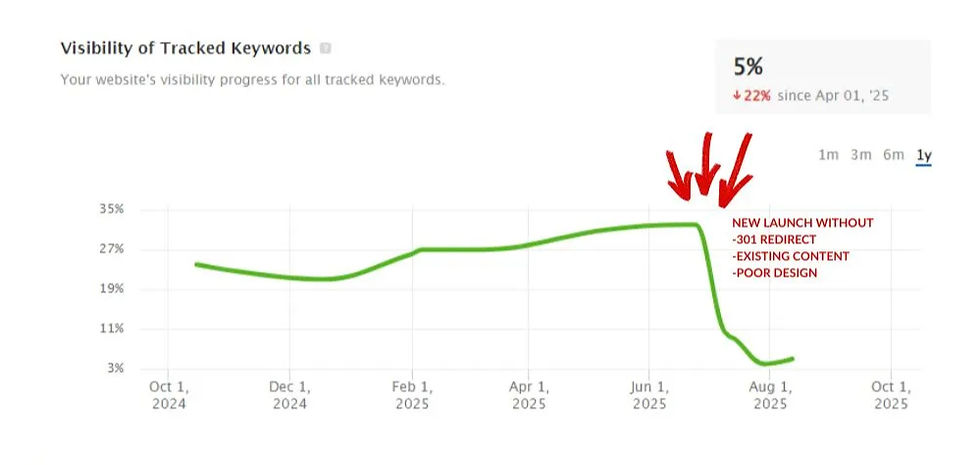
The result: an SEO catastrophe
The new website went live. What happened?
Within 2 weeks: visibility dropped from 32% to 11%Today (months later): still only 5% visibility
From 81 top 10 positions to 8
From 19 - 1st position rankings to 2 (one being their own brand name)
Featured snippets? Nearly all gone
Thumbnails? Vanished
Organic traffic? -84%

The website itself also left much to be desired: technical problems, inconsistent user experience, and a lengthy development process that didn't deliver the promised quality.
The lesson: why this happened
1. No 301 redirects = SEO suicide
Every URL on the old website had built up authority, backlinks, and ranking power. Without proper 301 redirects to the new URLs, all of this disappears. Google sees them as completely new pages without history.
It's like moving to a new house without forwarding your mail. Everything vanishes into the void.
2. Replacing SEO content = throwing away years of work
The content we had written was optimized based on months of analysis and testing. The new agency threw this away and rewrote everything—without SEO knowledge, without keyword research, without strategy. Result: content that might look nice, but that Google doesn't understand.
3. Switching platforms without good reason = unnecessary risk
Nothing was wrong with the existing platform. It worked, it ranked, and the client was satisfied. A platform switch without technical necessity only adds risk and complexity.
4. Impatience is SEO's biggest enemy
SEO is a marathon, not a sprint. The first months you build foundation. Months 4-6 you see growth. Months 6-12 you reap the rewards. Those who get impatient after 3 months and switch, start over at zero every time.
5. False promises are dangerous
Agencies that promise "everything can be better" without concrete data, without thorough analysis, and without honesty about risks? Red flags.
What we learn from this (and you should too)
301 redirects aren't optional. They're essential for every migration.
Don't just throw away optimized content. There are months of work in those rankings.
Don't switch platforms without good reason. If it works, let it work.
SEO requires patience. Don't expect miracles in weeks.
Data > promises. Ask for proof, not marketing talk.
Test migrations first. Do a soft launch, check redirects, monitor traffic.
Patience and strategy win. False promises cost you everything.
Case Study 2: From 6% to 36% visibility in 30 days
Metrics | Start | After 1 Month | Growth |
Visibility | 6% | 36% | +30% (500% increase) |
Keywords top 10 | 8 | 62 | +675% |
Keywords position 1 | 0 | 6 | +6 from zero |
Highlight keyword | Positie 48 | Positie 8 | +40 positions in 2 days |
Industry | Entertainment / Events | ||
Strategy | Redesign + basis SEO + diepte-optimalisatie testcase |
The starting situation: amateur work from previous agency
A business in a highly specific niche (entertainment and events—think laser shows and pyrotechnics) came to us. Their website had been "refreshed" 3 months earlier by a so-called professional.
The result? A cheap, unstructured, and amateurish website. Visually weak. Technically poor. SEO? Barely present.
Starting numbers:
6% visibility
8 keywords in top 10
0 keywords at position 1
For a niche with spectacular content (laser shows, pyrotechnics, visual impact), this was truly subpar.
Our approach: design, strategy, and a test case
1. Complete redesign: from basic to professional
We completely rebuilt the site in Wix Studio (versus the basic Wix version previously used). The result: a professional, visually appealing website with strong UI/UX.
Why Wix Studio? More control, better performance, and flexibility for custom code where needed.
Content strategy: Because the business works with laser shows and pyrotechnics, we went all-in on video content. Spectacle needs to be shown, not just described. Videos also drive higher engagement and longer sessions—both positive SEO signals.
2. Basic SEO during build
As always, we build with SEO in mind:
Structured content with logical H1/H2/H3 hierarchy
Strong internal link structure
Optimized images and videos for load speed
Structured data for rich snippets
3. Test case: deep optimization of 1 crucial page
To show the client what we can do, we optimized their most important page ("lasershow huren" / "laser show rental") with our complete formula:
SERP analysis of top 3 competitors with our Python scraper
Content completely rewritten and expanded based on what works in the top 3
Structured data added for FAQs and service schema
Local and international SEO impulses (Europe-focused, but with strong local focus for Belgium and Netherlands)
And this was just the beginning. Our complete strategy also includes extensive internal linking optimization and further depth optimization, but we reserve those for the follow-up phase. We don't give everything away for free—this was proof of concept.

The results: impressive for 30 days
After just 1 month:
Visibility: from 6% to 36% (+30 percentage points = 500% increase)
Top 10 keywords: from 8 to 62 (+675% growth)
Position 1 keywords: from 0 to 6
The keyword "laser show rental": from position 48 to position 8 in 2 days after our optimization
And that on a website that's only 1 month old.


The nuance: site-level keyword tracking
Of the 159 keywords we track for this project, they absolutely don't all rank high. And they don't need to.
Here's why that's completely normal:
We track keywords at site level—spread across all pages. Some keywords are semantically related ('laser show rental' / 'laser shows rental' / 'rent laser show'), others are broad vs long-tail variants, and still others are completely unique per page.
Can you rank for all 159 keywords? No, that's literally impossible. You optimize one page for a maximum of 1-2 keywords (our golden rule). The remaining keywords are:
Semantic variants that automatically rank along
Monitoring keywords for future content opportunities
Competitor tracking to see where opportunities lie
Trend identification for seasonal patterns
Think of keyword tracking as radar: you monitor broadly to see the full context, but you focus your optimization efforts on keywords with the best volume/conversion potential.
It's not about ranking for everything, but about getting the right keywords—those with conversion potential—to rank high.
And for this result—36% visibility in 30 days for a new website in a challenging niche—we're justifiably proud.
Conclusion: honesty and strategy win
SEO isn't a miracle cure. It's a strategic, data-driven investment that requires time, expertise, and patience.
The harsh truths:
Not every niche is equally achievable without significant budgets
Competition determines what's realistic
Rankings don't come in weeks, but in months
Shortcuts and false promises cost you everything
Website migrations without proper redirects are Russian roulette
What does work:
Honesty about what's achievable and what isn't
Data-driven strategy (SERP analysis, keyword research, content optimization)
Technical optimization within your platform's capabilities
Focus on 1-2 relevant keywords per page
Patience, commitment, and trust in the process
Realism about what we can and can't control: SEO gets you to the top of Google. But whether people click, and whether those clicks convert? That depends on your offer, your content, your price, and your sales process. We handle the visibility—the rest is up to you.
At Fennec Group, we believe in partnership, not empty promises. We're not here to tell you what you want to hear. We're here to help you with what works.
We show you the data. We explain what's realistic. We build strategy together. And we deliver measurable results.
No nonsense. No bullshit. Just honest, strategic SEO work that works.
Do you recognize yourself in these stories?
Stuck with a website that's not performing?Considering a website migration but afraid of traffic loss?Want to know if your niche is realistically achievable?Or simply looking for an agency that's honest about what SEO can mean for your business?
Let's have a no-obligation conversation.
We'll analyze your current situation, review your competition, and give you honest advice about what's possible. No obligations. No sales pitches. Just transparent advice from experts who know what they're doing.
Or just a conversation about your SEO goals. We don't bite. We do promise honesty.
Fennec Group: Shopify Partners | Certified Wix Studio Designers | Your partner in web design and digital strategy


Comments